How mobile money, digital payments, and the freelancing economy reshaped everyday life in Pakistan — told through data and the voices of those who lived it.
Mobile Money & Digital Payments
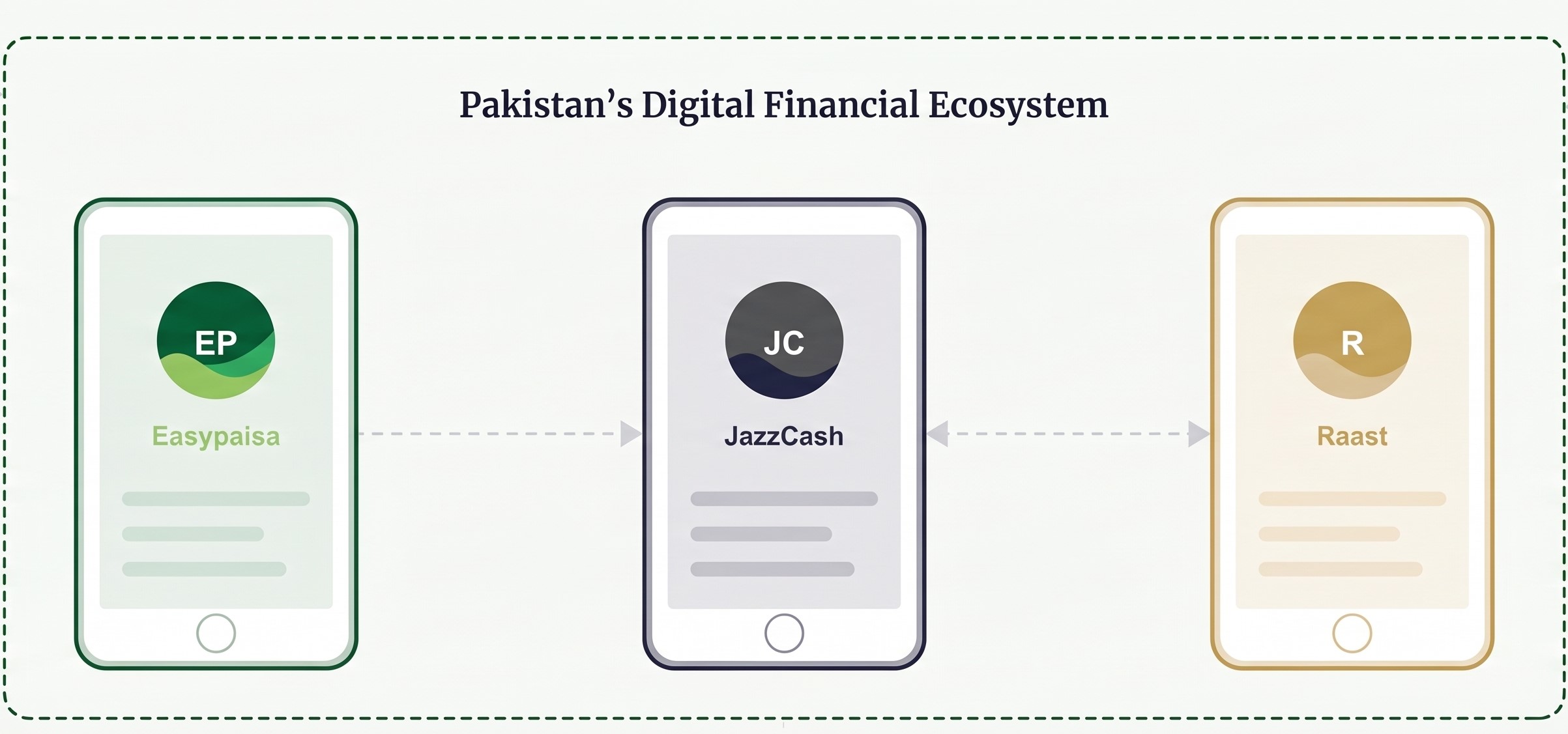
Pakistan's fintech landscape emerged from the convergence of mobile penetration and unbanked populations. The following platforms transformed how millions of Pakistanis send, save, and spend money.
Easypaisa was Pakistan's first branchless banking service, allowing users to transfer money, pay bills, and top up mobile credit via SMS and a network of retail agents. It pioneered mobile wallet adoption in a country where over 60% of adults were unbanked.
By 2014, Easypaisa had over 6 million active accounts and 75,000 retail agents across Pakistan, making it the largest mobile financial service in the country at the time.
JazzCash
Launched: 2012 (Mobilink, now Jazz)
JazzCash entered the market as Mobilink's mobile financial service, leveraging the operator's massive subscriber base to rapidly scale. It offered money transfers, bill payments, and merchant payments through both USSD and smartphone apps.
Following the 3G/4G rollout in 2014, JazzCash transitioned from USSD-based to app-based services, enabling QR code payments, online checkout, and integration with international remittance services.
Raast
Launched: 2021 (State Bank of Pakistan)
Raast is Pakistan's first instant digital payment system, built by the State Bank of Pakistan to enable real-time interbank transfers at no cost to consumers. It uses standardized addresses (Raast IDs) linked to bank accounts, eliminating the need for IBANs.
Raast represents a shift from operator-led mobile money to a national, interoperable payment rails system — a key step toward financial inclusion and digital sovereignty in Pakistan's financial infrastructure.
The Freelancing Economy
Pakistan's internet revolution created one of the world's largest freelancing workforces. Improved connectivity, affordable data, and a young, English-speaking population positioned the country as a global hub for remote work.
#4
global ranking
Freelancing Workforce
2024
Pakistan ranked among the top four countries globally for freelance workforce size, alongside India, the Philippines, and Bangladesh, according to Online Labour Observatory data.
Source: ILO Online Labour Observatory 2024
2M+
registered freelancers
Freelance Platform Users
2024
Over 2 million Pakistanis were registered on major freelance platforms including Fiverr, Upwork, and Freelancer.com, with IT and software development being the most common skill categories.
Source: PSEB Freelancer Survey 2024
$500M
annual export earnings
Freelance IT Exports
2024
Pakistan's freelance IT exports were estimated at approximately USD 500 million annually, making it one of the country's largest sources of foreign exchange from services.
Source: State Bank of Pakistan IT Exports Report 2024
Oral Histories
The statistics tell one story. The people who lived through Pakistan's internet revolution tell another. These are their words.